

Curriculum Customizer
Case Study
Project
UX/UI Design
Tools
Figma, Miro, Canva, Adobe Suite.
Partners
NAMLE Employees
Project Manager
Role
Solo Designer - User Research, UI Design, Product Vision Prototyping, and Wireframing.
Duration
8+ Months
Curriculum Customizer is an online space for media literacy educators to access resources, customize their curriculums, and connect with other educators in the field.
Introduction
For this project, I partnered with the National Association of Media Literacy Education (NAMLE), the leading nonprofit membership organization dedicated to advancing media literacy education in the United States and the design intervention responds to two of the questions brought up by NAMLE:
"How can we tap into and incorporate the work of the National Media Literacy Alliance to create resources and opportunities for our members?"
"How do we create resources and calls to action that work for our different membership communities (i.e. educators, organizers, artists, researchers, etc.)?"
To begin the process of finding a design intervention that responded to these questions, I had first to find out my research questions which were -
1. "What are the benefits of media literacy education for high school students in the United States?"
2. "What are the challenges that US educators face in teaching media literacy at the high school level?"
Problem
How might we make it easier for educators to teach media literacy in high schools?
Solution
My research findings explain the benefits and positive impacts of early integration of media literacy education in schools. However, I also found that while it benefits the students, it can be challenging for educators to integrate it into their current curriculum. I am proposing a website of resources for educators to find and customize lesson plans all at once.
Research
Field Scan
The research process of this project involved looking into projects and organizations that feel relevant to NAMLE and the proposed design intervention that I would be working on. Looking into what is currently being done in the field related to my project and how different or the same these works were, I found several projects and settled on these four as the most relevant - Edmentum, Aspen Institute, 21st century lessons, and Critical Media Project.
These existing projects helped me to inform what to bring into my design that would be unique from what is currently in existence.
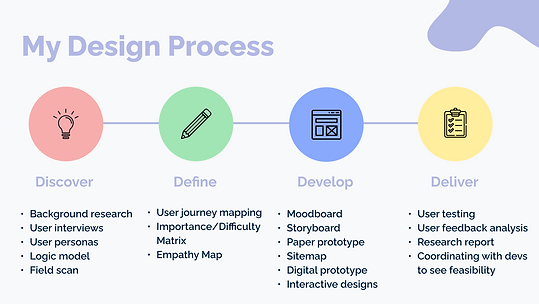
Process
.png)
Personas & Empathy Map
Based on research findings and interviews with different groups of people, three user personas were created with diverse backgrounds to represent our target audience and stakeholders. These personas were also used to create empathy maps and helped to gain a better understanding of the mindset of the target audience, and created scenarios related to their motivations, core needs, and pain points. These scenarios are fictional but inspired by real-world events and conversations happening on emerging platforms.


Design Process
.png)
Storyboard & Moodboard
.png)
Paper Prototype
.png)
Paper Prototype
.png)
Site Map
UI Design
.png)
Wireframes
High-Fidelity Screens

Landing Page
.png)
Home Page
.png)
Resources Page
.png)
Customize Page
.png)
Connect Page
Reflections & Next Steps
- One of the challenges that I faced during the process was figuring out the right design intervention that I believed would bring about solutions for the complex problems that were brought up. At first, it was narrowing down the target audience, then finding the right personnels to interview and then getting the right participants to test the design. The process really challenged me and helped me in gaining confidence and understanding, which led to my creating a design that was visually appealing & user-centered.
- My goal for this project was to be able to design a space that teachers felt safe and easy to use. As a designer, I aspire to create a great user experience for the users from visual design to interaction on the final product and being able to easily complete tasks with as little to no false starts as possible.
- I got positive feedback from the NAMLE team and I am looking forward to working with them to get the design up and running.
The next steps for this project involve:
Iterating additional feedback,
Working with engineers,
Promoting the website, and
Organizing workshops for intended users.
“We don’t teach children to read in order to protect them from bad books; we teach them to read and write because those are essential skills for navigating our world. The same should also be true for teaching media literacy skills in schools: the goal should be empowerment rather than protection”